Updated Vista 2040 General Plan
This public comment opportunity has concluded. On June 11, the City Council moved the Vista 2040 General Plan forward for consideration by Sierra Vista voters on Nov. 3, 2026 Residents can continue to correspond about the General Plan by emailing Vista2040@SierraVistaAZ.gov.
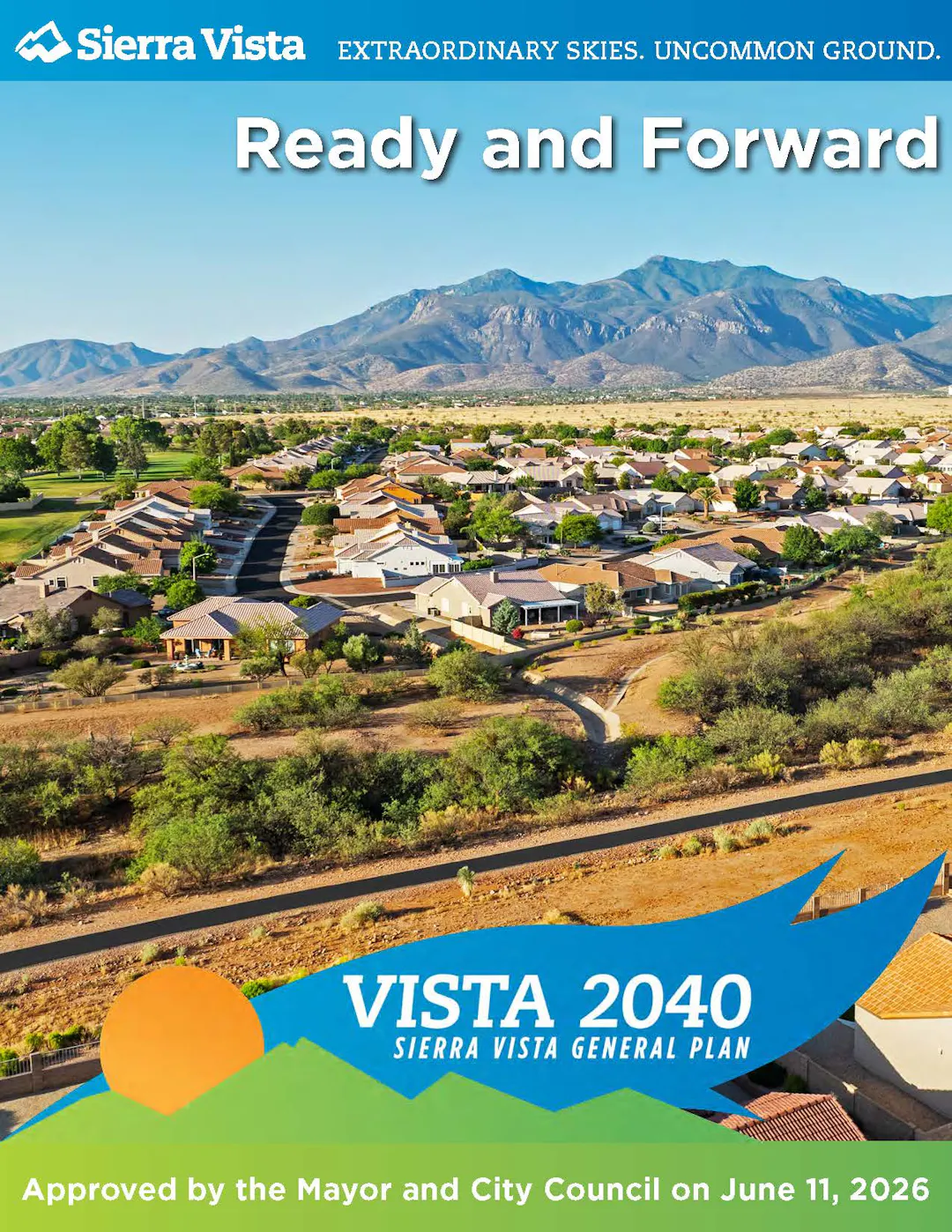
Review the updated Vista 2040 General Plan.
Frequently Asked Questions
Does this affect taxes?
No, the General Plan does not raise taxes or approve specific spending or projects. Infrastructure investments are evaluated separately through the City’s annual budgeting process.
Why is Vista 2040 required?
In 1998, amid dramatic growth that was reshaping Arizona communities and putting a strain on resources, the state legislature passed the Growing Smarter Act.
One of the most important provisions of the Growing Smarter Act required general plans for each city and county. The plans, or blueprints for growth, must be updated at least every 10 years and put to the public for a vote.
What happens if voters do not approve Vista 2040?
Since Vista 2040 was not approved in 2024, the City will continue using the previous plan, Vista 2030, to inform planning decisions. The process of developing an updated plan has begun anew and it will be brought back to the voters in the 2026 General Election, as required by state law.
How was Vista 2040 developed?
The City received extensive public input to inform the development of the plan, accepting hundreds of public comments for six months prior to creating the first draft. City commissions and local organizations were also directly engaged to offer input and additional feedback was sought once a draft plan was prepared. Now we're seeking additional input to rework this plan to better reflect our community’s vision.
Can Vista 2040 be changed after adoption?
Text and map amendments may be made to the plan in the future, even after being adopted by the voters. However, any proposed amendments to Vista 2040 would require public input through a formal public hearing process.
Does Vista 2040 result in direct expenditure of City funds?
No. Vista 2040 is planning and policy document that will inform the Mayor and Council as they make planning decisions and develop the City Council’s Strategic Plan, which is created every two years with near-term objectives. Any expenses require budgeting, and the budget is approved by Mayor and Council each year.
Who will use Vista 2040?
The community, the Mayor and City Council, Boards, Commissions, and other advisory entities, are all intended users of Vista 2040. Citizens can use the Plan to learn about the City, how to maintain and enhance the City’s quality of life, and the community’s long-term plans. The Mayor and City Council will use the Plan to formulate strategic plans that specify the long-range projects that city staff will focus on.
Does Vista 2040 change my zoning?
No. The Plan identifies broad-based land use categories upon which zoning is based.
Provide Input
This public comment opportunity has concluded. On June 11, the City Council moved the Vista 2040 General Plan forward for consideration by Sierra Vista voters on Nov. 3, 2026 Residents can continue to correspond about the General Plan by emailing Vista2040@SierraVistaAZ.gov.
You need to be signed in to comment in this Guest Book.
You need to be signed in to comment in this Guest Book. Click here to Sign In or Register to get involved
-
 Hear how citizen commission members and local residents helped shape the proposed Vista 2040 General Plan.
-

-
Community Development Director
I believe the City has done an excellent job in creating the latest version of the VISA Plan. I appreciate the hard work.
I have a few suggestions to strengthen portions of the plan that I am most interested in; the Sierra Vista Golf Center that I live adjacent to:
1. Add the Arizona Golf Industry’s Best Management Practices Guide into the operation and management of the Sierra Vista Golf Center and require that they be followed. The best management practices were prepared to create efficient course management for golf developments throughout the state. It provides quality playing surfaces and protects the environment. It contains management practices that we should follow including water conservation, pesticide use, providing wildlife habitat and movement pathways, pollinator protection, pollution management, landscaping, and others.
2. The golf course is a part of the City’s Park system. All tax payers are supporting the facility, not just golfers. Though the City needs to generate revenue though Paradigm, that should not be the only benefit the course should provide for all residents. The golf course also can provide other community benefits beyond golfing such as non-golf recreation, aesthetics, wildlife habitat and movement corridors, nesting areas and migratory pathways for birds, urban open space, and improved air quality. The current version of the plan is too narrowly focused on only golf. The Plan should commit to environmental stewardship of the Siera Vista Golf Center, and expand the opportunities for public enjoyment of the course beyond it being merely a “specialized recreation amenity’. The Plan should expand its goal for the course to be an amenity that provides year-round opportunities for recreation, instruction, community use, and environmental sustainability.
3. The plan should be reworded to encourage landscaping with native trees, shrubs, and other native vegetation on all public property, including the golf course. That contribute to improved air quality, water conservation, wildlife habitat, and community comfort.
4. The City should manage the golf course by adhering to its existing “Wash Drainage and Maintenance Policy” It should apply to maintaining washes on the golf course. This includes leaving natural vegetation around the washes and park areas, making great efforts to leave dense, well-nourished vegetation within the bank portion of the wash, and hardwood trees that are 6-inches or greater in diameter.
Thank you for your consideration of my comments on how to improve an already excellent plan.
We have now been here 13 years, and have noticed a few things along the way. The traffic on 92 has gotten worse, and those cameras seem to have made a comeback without any public notice. FLOCK camera intrusion? Just say NO... There are parks scattered everywhere, and usually are deserted(except Veteran's Park on Fry). Why add more? The licensing of Cannabis stores are an error by the city- just ask the adjacent businesses( like I did) They hate it! But there's the tax revenue that trumps those concerns apparently. The "homeless" people begging at the stores are still here, but their nearby parked cars have gotten quite a nice upgrade I've noticed, and Cops done seem to mind these people...
The talk about Water Conservation doesn't seem to affect the home Builders/Developers either. They, with the city's blessing, promise higher density housing as a band-aid, having more people per square foot flushing MORE "low-flow" toilets and showers, etc...There also seems to be a desire to grow this town into a "Mini Tucson" eventually, as continued growth is a priority... The recurring "Temporary" city taxes frequently added to our purchases are always an irritant, as the City/County folks are always scheming for ways to fund pet projects. Live within our means?...Living in the Canyon De Flores tract has become a daily symphony of continuous/constant barking dogs surrounding us all around every day, not to mention the frequent, daily sirens wailing on nearby 92, so as we go to our high-density USPS mailbox cluster to get the mail, and drive all the way up to Fry for some groceries, we can't imagine living in a bigger, more crowded city, even with the present minor irritants here.
I appreciate the opportunity to comment!
Several items to consider, especially in communicating with the community.
1. Communicate, communicate, communicate and overly communicate by addressing the fears and providing solutions to the fear. For example, Joe Doe is concerned about the increase in taxes. "This plan has nothing to do with taxes and will not increase taxation. This plan provides direction on how to use our available resources in a way that protects our priories of ....... " Jane Doe is concerned that the small town vibe will change. "We have developed this plan with public input with the desire to continue our small town/neighborhood feel with intentional measures and strategies as we value that. If we do not put a plan in place as such, we will have no control over the growth and how it happens which may break down the small town feel...."
2. Plans are only as good as the funds are available for implementation. How will the priorities be determined for implementation? This calls all department into accountability as well as the current mayoral and city council leadership. If there is no strategy for determining priorities, it will be easy to justify the current leadership’s desire in any portion of the plan while negating or not concentrating on other areas.
3. At last night’s Public Hearing, I provided these written comments: from the introduction.
1.0 Introduction
1st sentence: “… its setting, its people, and its purpose.”
Question: What is Sierra Vista’s purpose?
1st paragraph, 3rd line: “… balance of natural beauty, military heritage, and small city livability.”
Recommendation: “… balance of natural beauty, strong military presence and heritage, and small city livability.”
Rationale: We have an existing military presence—it isn’t just about our military heritage.
3rd paragraph, 3rd line: “….civic identity, and a stable economy anchored by national defense, education, healthcare, and public service.
Comments: (1) Are the attributes of stable economy listing in priority order? The existing order implies the priority and while national defense and the Fort is key to our economic viability, is this the message we want to portray? (2) Education is listed which implies it is a priority—if so, why are we closing 2 schools? Isn’t the priority really of rural advanced education/higher ed? (3) Healthcare—if this is a priority, why do so many people go to Tucson for their healthcare? There are many concerns in this area due to our ruralness and lack of specialized care, i.e., neurology where there is only one neurologist for the county. In actuality, this hardly represents a priority.
We are Arizona’s Hummingbird capital and nicknamed America’s capital by numerous publications locally, state, regionally, nationally and internationally. “Almost half of the hummingbird species found in SE Arizona are rare to unheard of elsewhere in the U.S.A”. (SABO) This is an incredible and unique feature of our area, being that we are in an area of “five major biographic regions, yielding wildlife and birds found nowhere else on earth.” (SABO) There is no mention on that specifically in the document, only a general reference to the area.
This leads me to a deeper concern. Yes, I understand the requirement for this General Plan. I understand it is to be “general” in nature with policies and guidelines rather that prescriptions and tactics. However, at its core it does not capture the identity and purpose of Sierra Vista. We researched for three years before moving here. It had nothing to do with Fort Huchuchuca, but everything else to do with the community’s other benefits. We take great joy in being here. Yet, from our time here (since Aug 2021), Sierra Vista does not have a clear sense of identity of who we are or who we want to be. It isn’t just about our military heritage and the great contribution of Buffalo Soliders—that’s our past. It isn’t just about holding onto small town vibes and norms which add to our charm and beauty. It is about so much more.
I have served on the Tourism Commission for 2++ years and we have struggled with this issue from our earliest of conversations as we have no focused identity or anchor point with which to promote, to celebrate, to share our current identity and launch us into the future. Vision 2040 has no vision other than to keep the status quo, to continue to breathe life into the areas of the town that were and are no longer. We cannot forsake our past, nor continue to dwell on maintaining our present (pouring more resources into a dead area such as the West End) without looking with fresh eyes on who we want to be and what we can become as a community. The “Good Old Days” were not so good when we lived them—only in retrospect because it is easier to live in the past than embrace the future because it is too scary.
We live in an absolutely incredible geographical area filled with benefits too great to number—those who come in from the outside and choose to live here know that. Let’s encourage our residents and especially long-term residents to see what they have without fear of losing it. If we do not change and walk with hope into the future, filled with unknowns and new discoveries, we may as well die. (We are not the town that is too tough to die!)
Rebecca Smith
616 Carmelita Place, SV
beccalynnsmith@aol.com
It is frustrating for residents in the NIcksville/Hereford area that we are so closely positioned and integrated with Sierra Vista, but have no voice in local elections. Is there any plan to formally incorporate our area into Sierra Vista city limits? We can't even vote for Mayor.
Oh, and just one more thing: given the emphasis of the plan on the natural beauty of Sierra Vista, I hope the lure of soliciting bids from huge energy- and water-sucking data centers has absolutely no place in the future of this town.
The plans to expand the multi-use paths is certainly appealing! It would be useful to the voting public to know more about the specific goals therein: which paths do you plan to connect and/or where? Somebody's comment here about shade seems brilliant, especially if there are some low-water trees that might thrive along our trails and offer a break from the heat--this might be wishful thinking, but it'd be great to have more data on this.
The West End development thus far looks great, but I find myself intimidated walking there. It's a lot of parking lots and empty storefronts and very wide areas of empty asphalt. When I think about other walkable cities I've visited, there are very clear residential blocks abutting local businesses with store fronts lining the downtown streets. Sometimes those business have an apartment above them--that is, mixed-use zoning seems to promote the sense of a city belonging to its residents. The folks walking downtown might be a couple taking their dog out or tourists taking photos or kids going out for ice cream. Having centrally located grassy or at least natural areas to gather also makes it possible to go downtown without having a specific store in mind--folks can walk around shops, get some food, have a picnic, and generally spend an idle afternoon enjoying the weather. I think having a clear idea about what sort of space it should be (whether that's plazas with no cars, pedestrian-focused blocks with parking a few streets over, etc.) seems like it can guide infrastructure changes in a way that anticipates and promotes a friendly downtown area. It also seems prudent to have very specific plans about incentivizing local businesses. As Angbov, below, wrote, the only way to have local businesses is to let them into local neighborhoods. Yes, Angbov, yes!
Housing market costs are of course a factor in growth and development, and keeping things affordable but also safe seems like the major balancing act for development of a downtown. There are some brilliant papers written up on the importance of mixing up housing types and prices. I hope the city can incorporate the advice of these studies.
I agree with another commenter below about tying land development to protecting the aquifer. Infill over greenfield development seems to be generally more prudent and cost-efficient, but I also wonder about integrating the natural environment deliberately into future development (parks and preserves can make urban areas overall better for mental health, according to studies on both noise pollution and the importance of just looking at trees for our chronically indoor society). The nature around is, after all, what makes our multi-use paths a boon in the first place. And, yes, Angbov, let's protect lines of sight and the gorgeous sunsets!
Given the fort and the college are major employers here, I would love to see our city's burgeoning identity aligned with their development goals. An example that comes to mind is Cochise College built dormitories across from Patterson Observatory and the consequence is a row of beacon-like streetlights burning brilliant paths across our retinas as we all gather to appreciate the Huachuca Astronomy Club's free nights at the observatory. All the HAC's careful work is undermined by these spotlights. When I asked the astronomers there if anybody had asked the college about it, they said they lobbied for a different solution and the president simply said, "I won't compromise the safety of my students." This was perhaps an insurmountable issue, but it is also the case that the president of Cochise College single-handedly negatively impacted the quality of a long-standing volunteer organization's extraordinary educational efforts with little regard for the wider public's engagement with shared space. The local community of master gardeners have also struggled to gain any sway with the president of the college, which resulted in parking lots where a group of volunteers were previously beautifying. The Discovery Gardens are another community asset that the larger public should be able to protect. As a long-term resident of this community, I feel it would be valuable to work with these two large employers to protect our dark skies, our aquifer, and our abundance of retired astronomers and gardeners offering their services to the public for free. Surely we can work together to the mutual benefit of all.
On that note, there are so many wonderful developments in the technology of lighting that Sierra Vista's 2040 plan should include incorporating some of the shielded lighting options and adopting dark-sky standards. There are many cities in the southwest that have successfully maintained their dark skies and made them part of their tourist identity. As an earlier commenter remarked, this would also support Fort Huachuca’s night‑training needs. And as the commenter below remarked, this is essential to Space Force development. Here, here!
Policy 2-2.2.1:
Promote combined use zoning in new build areas over single use structures. Whether it’s apartments with shopping areas on the ground floor or business fronts with homes in the same building or lot; combination living and work spaces promote localized specific growth zones. Concentrating and clustering commercial zones is what drives traffic to those areas, thus congesting the area. Combination residential/commercial areas allow localized access to service facilities. (There is no such thing as a neighborhood market, café, bookstore, curio shop, co-op, vegetable stand, bakery, etc if these businesses are not allowed to be in neighborhoods.)
-----
OBJECTIVE 2.2.3:
Program for industrial and large distribution facilities and warehouses to be on the periphery of the city with a focus on commercial access nodes with residential zoning filling out the city land space.(Why do you want warehouses and truck routes going through the city and across home areas?)
-----
OBJECTIVE 3-1.4: Require new build non-residential facilities to be designed in a way that includes solar energy structures or capabilities on the roof of the facility. Require these solar energy capabilities to be incorporated into the existing regional power structure. (We live in the sunniest place in the country, let’s start using that ball of fire in the sky.)
-----
5 Housing and Neighborhoods:
Work with Fort Huachuca on this. Sierra Vista home values are driven by the government income and allowances provided by the installation. Otherwise, we would be the same as Safford. Every time BAH, or per diem, or any Fort Huachuca localized allowances go up, that directly drives the pricing of real estate off post. Lower the amount of money the government personnel get for this locality and you can lower the cost of housing for everyone not directly affiliated with the federal government.
------
6 Economic Vitality: Lean into the fact that Sierra Vista is the center of the Cochise County universe (whether or not the other cities like it).
----
9 Transportation and Circulation: Don’t ever let anything designed like the Walmart shopping center traffic flow ever be allowed again. Undo the damage you did to the “West End” people actively avoid that area now.
-----
GOAL 9.2: Start looking at a third major route around and through the city. The current two (Hwy 90 & 92) and (Fry & Buffalo Soldier) are reaching saturation levels. Colonia de Salud is one potential primary thruway by continuing Colonia de Salud from E Hwy 90 up to Charleston, connect East Snyder to Colonia de Salud, and bring Colonia de Salud down to East Buffalo Soldier trail. This would provide a parallel N/S route to Hwy 92.
-----
12 Cost of Development: Increase and strengthen conflict of interest transparency by publicly posting fiscal connections between all city employees and city service contracts.
-----
3.2 OUTDOOR LIGHT CONTROL: This is absolutely critical to the current efforts of Sierra Vista and Fort Huachuca to bring in Space Force capabilities. Dark skies are operationally critical for optical space surveillance systems like GEODSS.
-----
4.2 REDEVELOPMENT AREA DESIGNATION” The plan emphasized repositioning Fry Boulevard as a slower-speed, more walkable community main street; improving corridor appearance and
functionality; encouraging adaptive reuse and infill development; and supporting small
businesses through targeted incentives.”
It’s not more walkable if you have to drive there, find a parking spot, then walk around. “Walkable” areas are areas the negate the need for an automobile by having intermixed residences and commercial space. All the West End Plan did was make it more difficult to get to the West End to walk around it.
-----
7.2 PARK SYSTEM INVENTORY
There is a clear and noticeable lack of parks in two areas of the city. The central-southwest area and the north east area. (Look at Map 5-1 – Generalized Neighborhood Planning Boundaries)
Again, people in these areas have to drive to a park to go for a walk.
-----
8.3.1.3 Police Operations: get your cops out of their cars and out of the office and engage with the community. Be around. Don’t only be seen when you are hassling someone. Be naturally ingrained. Yes, you have to actually care about the community rather than just getting paid to be on the job, but that’s how police and community build relationship, by engaging throughout the day with the people you police, while simultaneously not being down people’s throats making them think you are trying to get them in trouble.
-----
General statement: You go on and on about the natural beauty of Sierra Vista. If that is our key feature and draw, then what are we doing to protect it. Are we considering lines of sight to the mountains and world class sunsets when new structures are built? Are we putting constraints on skyline protrusions? Are we working towards decreasing light pollution at night and turning off nuisance lights? Safeguard the natural beauty you lean so heavily on.
I feel like Hwy 92 corridor is not being utilized fully. There could be grocery stores there, plus a community park. Holiday has a pool, but only homeowners can use it. Another pool, more shopping opportunities could be established there, and it would help people who live on the east side of Hwy 92, who live in mobile homes, and lower income housing. Castle and Cooke with Holiday Subdivision was supposed to have done that, i understood, but it did not accomplish that. There could be so much more city growth out that way. I know the county comes into the equation there, but perhaps, more interaction and working together would be good so both entities could grow and become better.
Generally, a good plan. More needs to be done to reduce waste of water. People should not be washing down their driveways. We need to prohibit water use like Albuquerque does.
Regarding transportation, the buses need to run in both directions and run on Sundays.
I was disappointed that recycling has not been a greater focus. I know the curbside service ended in 2019. I do subscribe to Recyclops for curbside. However, this needs reconsideration. We seek to improve our residential neighborhoods, yet residents are forced to lay trash bags on the curb for pickup. It's an eyesore. It attracts animals that tear open the bags. It's a disgusting option compared to the nice blue containers. Almost any decent-sized city offers curbside recycling.
Speaking to the arts and humanities, I am pleased that is included in the plan, but think you need more specifics. For one, how can the West End revitalization include space for performances and/or small conferences ans events? Book festivals, writer conferences, etc. You need flex spaces that can be performance areas and are walkable to cafes and hotels and little shops. Downtown Flagstaff could be an inspiration. And UA of Cochise College could be a partner for some of it. If you build it, they will come, etc etc.
The townies have resentment towards that side of town and the people who own the buildings are rumored to rather they be empty than rented at a reasonable rate. That needs to be addressed at the city level somehow.
I would also share that UA garden extension does an amazing school gardening program in Tucson and I think families would LOVE that here. Plus, an expansion of the Farmer's market on a day/time when we can all go and particpate, not just the reigning court of retirees.
If we want things like good doctors, we have to have things for the doctor's wives.
Think outside the retiree box.
That is my 2 cents. Good luck and thank you for trying to help SV thrive.
I support the plan’s emphasis on multimodal transportation, but the walkability policies in Volume 1, Chapter 9 (Policies 9‑3.1.1 and 9‑3.1.3, pp. 59–66) need measurable commitments. As someone who regularly uses Sierra Vista’s multi‑use paths and wants to see a more walkable, connected city, I would like to see specific targets for sidewalk infill, safe crossings, and new multi‑use path mileage. Volume 2 notes that Sierra Vista already has more than 30 miles of multi‑use paths, but it does not identify priority gaps or timelines. Adding measurable goals would ensure walkability becomes a defining feature of Sierra Vista’s future rather than an aspirational statement.
Walkability in Sierra Vista also depends heavily on shade and heat‑resilient design, which is not addressed in Volume 1, Chapter 9 or Chapter 7. As someone who walks and bikes frequently, I believe the plan should include shade requirements for major corridors and multi‑use paths. This would improve safety, comfort, and year‑round usability, especially during the hottest months.
I would also like to see the plan address the use of traffic circles as an alternative to traditional signalized intersections. Vista 2040 does not currently mention roundabouts in Volume 1, even though they are a proven tool for improving safety, reducing severe crashes, calming traffic, and supporting walkability. As someone who values pedestrian comfort and wants Sierra Vista’s major corridors—especially in the West End—to feel safer and more inviting, I believe the plan should encourage the use of modern roundabouts where feasible. Roundabouts also reduce long‑term maintenance and energy costs compared to traffic signals, which aligns with the plan’s goals for fiscal responsibility and sustainable infrastructure.
The plan mentions “sense of place” in Volume 1, Chapter 2 (Goal 2.1 and Objective 2‑1.6, pp. 22–35), but it does not define what Sierra Vista’s urban identity should be. Volume 2 confirms that most of the city was built in a suburban, auto‑oriented pattern, while the West End is the only area with a traditional grid. As someone who wants Sierra Vista to develop a stronger, more coherent city feel, I would like to see clearer urban design guidance. This could include street typologies such as pedestrian‑priority streets, mixed‑use main streets, and neighborhood slow streets; block patterns that encourage shorter blocks and more frequent intersections; and design standards such as build‑to lines, storefront transparency requirements, shaded sidewalks, and limits on large surface parking lots. These tools would help create a more walkable, human‑scaled environment that supports local businesses and community life.
I strongly support the focus on the West End in Volume 1, Chapter 4 (Policies 4‑1.2.1 through 4‑1.2.4, pp. 40–43), and I appreciate the investments the City has already made in streetscape improvements along Fry Boulevard and Garden Avenue. However, the plan should commit to continued investment and to creating incentives for small, pedestrian‑facing businesses. The West End will not become vibrant without a strategy to reduce long‑term vacancies, support local entrepreneurs, and encourage active ground‑floor uses. As a resident who wants Sierra Vista to have a lively, walkable core, I believe the plan should include targets for reducing commercial vacancies, expanding outdoor dining and public spaces, and supporting mixed‑use redevelopment that brings more residents and businesses into the area.
The plan acknowledges water conservation in Volume 1, Chapter 3 (Policies 3‑1.3.1 through 3‑1.3.6, pp. 35–40), but it does not connect water availability to land‑use decisions. Volume 2 shows that Sierra Vista has enough land to accommodate projected growth without expanding outward. As someone who cares deeply about protecting the aquifer and the San Pedro River, I believe the plan should explicitly tie growth areas to long‑term water availability and prioritize infill over greenfield development. This would help protect both the environment and the city’s long‑term sustainability.
I appreciate the plan’s commitment to coordinating with Fort Huachuca in Volume 1, Chapter 2 (Objective 2‑1.3 and Policies 2‑1.3.1 through 2‑1.3.3, pp. 22–35), but it should explicitly recognize aquifer stability and dark‑sky preservation as mission‑critical factors. Both Fort Huachuca and Cochise College are major employers whose practices can either support or undermine the city’s water‑management and dark‑sky goals. As a resident who values the fort’s presence and wants to protect federal investment, I believe the plan should integrate water‑related compatibility, lighting standards, and coordinated conservation efforts into its land‑use policies, not just noise and accident potential zones.
Sierra Vista’s dark skies are a major community asset and an important draw for astronomers and night‑sky tourism, yet Volume 1, Chapter 3 (pp. 35–40) does not include any policies to protect them. As someone who values astronomy and wants Sierra Vista to remain a dark‑sky destination, I recommend adding policies requiring fully shielded, low‑Kelvin outdoor lighting and integrating dark‑sky standards into new development and redevelopment areas. This would also support Fort Huachuca’s night‑training needs and protect one of the region’s most distinctive natural resources.
Volume 2 notes that Sierra Vista is one of the most affordable small housing markets in the nation, which is a major strength. As someone who wants to prevent the affordability crisis seen in Tucson, I believe Volume 1, Chapter 5 (Goal 5.1 and Policies 5‑1.1.1 through 5‑1.1.5, pp. 43–47) should go further by encouraging missing‑middle housing, accessory dwelling units, and mixed‑use residential in the West End. At the same time, it is important that the West End not become a concentrated “affordable housing district” with the social challenges that often accompany large clusters of subsidized housing. The downtown area needs to remain safe, mixed‑income, and family‑friendly. A balanced approach that mixes market‑rate housing, small apartments, live‑work units, and limited income‑restricted units would support both affordability and long‑term neighborhood stability.
Finally, Volume 2 shows that development timing is constrained by infrastructure availability and market absorption. As a resident concerned about fiscal responsibility, I believe Volume 1, Chapter 2 (Policies 2‑1.5.1 through 2‑1.5.4, pp. 22–35) should reevaluate growth areas to ensure they align with infrastructure capacity and water availability. Prioritizing infill and reinvestment would reduce long‑term maintenance costs and support more sustainable growth.
Southern Sierra Vista lacks a significant playground. Specifically the area North of Canyon De Flores, West of Camino Bella Rosa and East of St Andrew’s drive is an ideal location. It is already designated as a park, it is not part of the flood plain, and it would not take away from the nature walk portion of Garden Canyon Park. Essentially it is an undeveloped, city owned, ideally located lot. This park needs to be commensurate with the playground area of Veterans memorial park. As it is, the nearest playgrounds are a small neighborhood playground in the holiday subdivision or driving to Tompkins or Country Club park. All of these, for residents South of Buffalo Soldier Trail are beyond walking distance for most. A large playground at this location would provide the city with large playgrounds on the North, central, and South portions of the city. As it is, children South of Buffalo Soldier Trail are being underserved. The 2040 plan parks and rec section talks about general goals, but does not get into specifics, such as this recommendation.
The following are my comments on the VISTA 2040 Revised Draft. I have made some of these comments before, but they were not acted on. Please reconsider acting on them, as it should increase your chances of approval besides making Sierra Vista a better, more prosperous place to live in/move to:
Include the objective of purchasing the water companies that operate inside Sierra Vista in order to support water conservation in OBJECTIVE 3-1.3: Promote long-term water conservation and protect groundwater resources to support community sustainability and environmental health (page 38). The city tried unsuccessfully to purchase at least one private water company in the past. I believe this objective should not be lost sight of in the future. With ownership of the city’s water supply, the city could better regulate water usage within the city. This would be good for the environment, would lower water usage and the resultant sewage treatment requirements, and help ensure that Fort Huachuca or city expansion was not negatively impacted.
VISTA 2040 references other Sierra Vista planning documents, but VISTA 2040 does not include any way to easily reference these documents such as a web link or a Document References section where the various referenced documents are listed along with how to easily access them. An example of this is the Parks and Recreation Master Plan (2021-2032) mentioned on page 140. Another example is VISTA 2030, which included the Veterans Memorial Park Master Plan as an appendix.
There is a 7.2.5 Pedestrian and Bicycle Connectivity subsection on page 143, but there is no subsection on Pedestrian and Bicycle Safety. As the public facilities like parks and multiuse paths/trails/equipment (e.g., swings, slides) become more crowded the risk of accidents and friction over the sharing of multiuse public facilities will increase. These risks could be mitigated by the development of generally accepted safe use and shared use guidelines. These guidelines could be presented to the public in various forms, such as educational brochures and videos, signage, lettering on pathways, etc. If the safety risk was high enough, then enforceable ordinances could be considered.
There is a 7.2.6 Vehicular Access and Parking subsection on page 144, but there is no subsection that outline priorities for the development of parks and recreation facilities, such as a high priority for adequate restroom/toilet facilities and parking. How can you thoroughly enjoy a park if there is not enough places to properly park or go to the bathroom?
There is a 8.8.4 Sierra Vista Municipal Airport subsection on page 163, but there is no subsection on Multiuse Paths which should include information on pedestrian and bicycle safety, for instance. I was told that Public Works is responsible for the multiuse paths outside of the city’s parks. Consequently, just like my earlier comment on a lack of a Pedestrian and Bicycle Safety subsection in CHAPTER 7: PARKS, RECREATION, & OPEN SPACE, I would like to suggest that a Multiuse Paths subsection should be added that includes information on pedestrian and bicycle safety. As the public facilities like multiuse paths become more crowded the risk of accidents and friction over the sharing of multiuse public facilities will increase. These risks could be mitigated by the development of generally accepted safe use and shared use guidelines. These guidelines could be presented to the public in various forms, such as educational brochures and videos, signage, lettering on pathways, etc. If the safety risk was high enough, then enforceable ordinances could be considered.